You have two pricing tabs open at eleven at night, the evening before a live sale: ManyChat’s says $17 a month. Chatfuel’s says $69. Neither number tells you the thing you actually need to know, which is what happens to the comment itself — does anything reply under it, in public, where the next forty people scrolling past can see an answer already sitting there, or does the whole job move quietly into an inbox nobody’s watching?
That’s the real question behind “ManyChat vs Chatfuel,” and it doesn’t get answered by the price on the homepage. Below is what each one actually charges, what changed in ManyChat’s billing this year, what’s bundled into Chatfuel’s plan, and — because both are chatbot-building platforms wearing a comment-automation checkbox in their feature list — when the honest answer is neither.
We build Mentbot, a comments-only tool that shows up near the bottom of this page. Every price below comes from the vendor’s own pricing or help pages, cited with the date we checked.
| ManyChat | Chatfuel | |
|---|---|---|
| Billing model | Per active contact | Flat, by plan — unlimited contacts and messages; only AI processing has a fair-use limit |
| Entry price | Essential $17/mo ($14/mo billed yearly) | Business $69/mo (10% less billed yearly) |
| Free tier | Yes — 25 active contacts/month, ManyChat branding on your first message | No standing free plan; free trial only |
| Facebook comment automation | Yes — comment triggers, set per post | Yes — Business plan replies to post and Reels comments automatically |
| Yes | Yes | |
| Flow builder | Yes — the most developed in the category | Yes — visual builder plus AI that qualifies and sells in the chat |
ManyChat figures verified against manychat.com/pricing and ManyChat’s help centre, 21 September 2026. Chatfuel figures verified against chatfuel.com/pricing, 21 August 2026 and re-checked 15 September 2026, and limits.chatfuel.com, 15 September 2026.
On 2 March 2026, ManyChat replaced its old plan structure with one priced by Active Contacts — anyone you interact with in a calendar month, counted once no matter how many messages you exchange. The new free plan covers 25 active contacts, up to four live automations, two channels and one user, with ManyChat’s own branding on your first message. Paid plans run Essential at $17/mo ($14/mo billed yearly, 250 contacts), Pro at $39/mo ($29/mo, 2,500), Business at $99/mo ($69/mo, 7,500), and Advanced at $199/mo ($139/mo, 25,000), with overage priced per extra contact — from $0.10 down to $0.004 depending on tier. AI features are included from Pro up. Verified against manychat.com/pricing, 21 September 2026.
If you opened your ManyChat account before that date, check your own billing page before assuming the new numbers apply to you. ManyChat’s help centre says free accounts have already been moved onto the new model regardless of signup date, while older paid accounts are being migrated country by country. Source: Manychat Help — Essential plan and Free plan, checked 21 September 2026.
The number that matters for comment automation specifically: a product post that pulls a few thousand commenters can push a Business-tier account — 7,500 contacts included — over its allowance in a single afternoon, and every one of those people counts as a billable contact whether or not they ever reply to your message.
Chatfuel doesn’t meter contacts at all. Its plan-limits page states that every plan includes unlimited active contacts and unlimited messages — the only metered resource is AI processing, capped by a fair-use allowance per billing period. Source: limits.chatfuel.com, checked 15 September 2026.
Business is $69/month billed monthly, or 10% less billed yearly, and includes $20 of AI credits a month. There’s no standing free plan — every plan starts with a free trial instead. What’s bundled into that $69: a visual flow builder, AI that qualifies leads and sells inside the chat, bulk WhatsApp campaigns, CRM sync, and ad-attribution tracking, across Facebook, Instagram and WhatsApp in one platform. The plan’s own feature list includes replying automatically to post comments and to Reels comments. Verified against chatfuel.com/pricing, 21 August 2026, re-checked 15 September 2026.
Run out of the AI allowance and the bot pauses — AI replies stop until the period resets, you renew early, or you connect your own OpenAI key. Everything else on the plan, including the comment replies, keeps running regardless of contact volume.
Neither tool is the wrong choice. They’re built for different jobs, and each has a real strength worth naming honestly.
ManyChat is the better pick if you build multi-step funnels. “Comment WORKSHOP, get the PDF, three-message drip, book a call” is what it was built for, and its flow builder, template library, and decade of agencies and courses around it are the most developed in the category. If your contact count stays under 250 and your bill sits at $17–29 a month, and you’re actually using the flows, the per-contact model is not a reason to leave.
Chatfuel is the better pick if your posts go viral unpredictably and you still want a flow builder. Unlimited contacts and messages mean a post that pulls thousands of commenters costs the same $69 as a quiet month — the one advantage ManyChat switchers are usually looking for, minus the actual switching. Its AI lead-qualification and WhatsApp coverage inside the same platform are genuine capability, not filler.
Where both fall short for the same reader: if the job on your page is “reply publicly, send the price in Messenger, maybe hide the comment,” you’re paying flow-builder or per-contact prices for a flow builder or contact meter you never touch.
If the honest answer to “what happens after the comment” is a public reply and a private Messenger message, and nothing past that, both tools above are priced and built for more than your job needs.
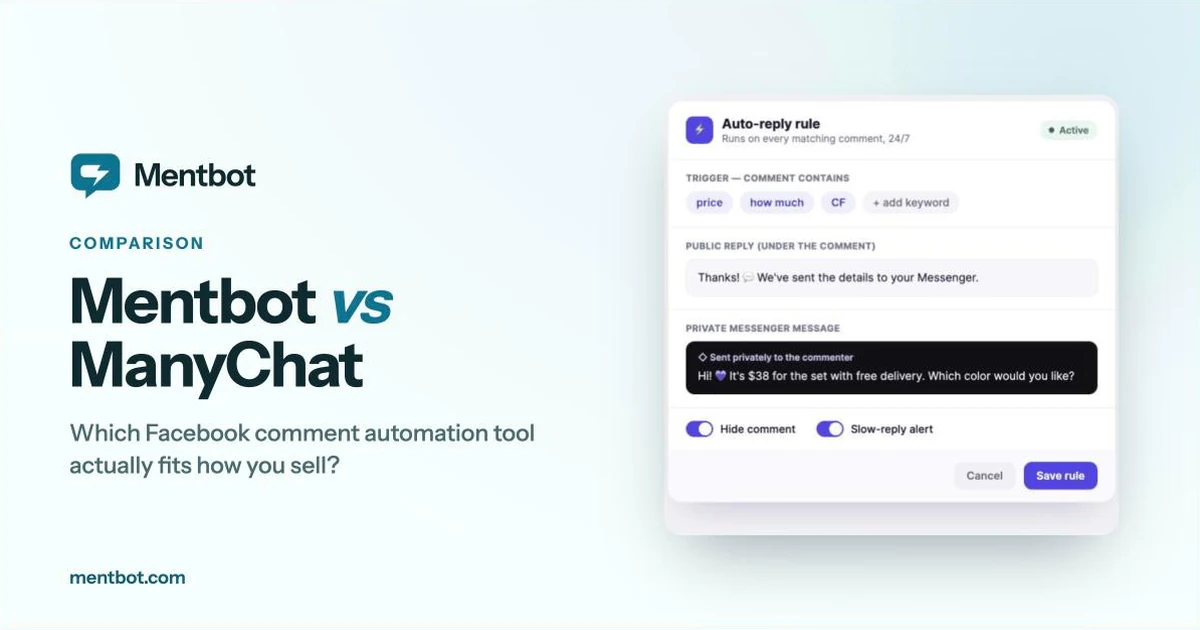
Mentbot does the one thing: a comment lands, it gets a public reply and a private Messenger message, and it can be hidden — one rule per page, covering every future matching post, with no flow to build and no contacts to count. Pricing is flat by daily comment volume, not by audience size: $9/mo (100 comments a day), $19/mo (1,000), $29/mo (3,000), $49/mo (5,000), every feature on every plan, unlimited Facebook pages. Every signup starts on a 14-day Pro trial, free, no card.
It doesn’t do flows, drip sequences, or WhatsApp — if you need those, the sections above are for you. If comments are the whole job, this is.
Is ManyChat or Chatfuel cheaper? It depends entirely on your contact count. ManyChat’s list price starts lower ($17/mo Essential vs Chatfuel’s $69/mo Business), but ManyChat’s bill grows with the number of people who comment on and message you; Chatfuel’s $69 stays flat whether ten people or ten thousand interact with you that month. Run the math on your own comment volume before comparing sticker prices.
Does Chatfuel charge per contact like ManyChat? No. Chatfuel’s plans include unlimited active contacts and messages; the only fair-use limit applies to AI processing. That’s the main reason people move from ManyChat to Chatfuel rather than the other way around.
Which one has a free plan? ManyChat does, capped at 25 active contacts a month with ManyChat’s branding on your first message. Chatfuel has no standing free plan, only a free trial on every paid tier.
Do I need a flow builder just to auto-reply to Facebook comments? No. Both ManyChat and Chatfuel bundle comment automation into a much larger chatbot platform, which is the right trade if you use the rest of it. If you don’t, a comments-only tool like Mentbot covers the same public-reply-plus-DM motion without the platform price attached.
If you’re choosing between these two specifically, start from what happens after the comment, not from the sticker price. Building a funnel points you to ManyChat; wanting a flow builder without contact math points you to Chatfuel; wanting neither points you at a comments-only tool.
For the wider field, our comparison of seven ManyChat alternatives and our Chatfuel alternatives roundup each go deeper on one side of this choice, and our head-to-head against ManyChat covers the comments-only argument in more detail. If comments are the whole job, Mentbot’s 14-day trial is free and doesn’t need a card to start.